There's a lot of noise right now about AI agents — systems that don't just answer questions but go off and do the work. It's genuinely powerful. It's also not always what you need. The trick is matching the level of help to the task, instead of reaching for the most autonomous option because it sounds impressive.
Two different kinds of help
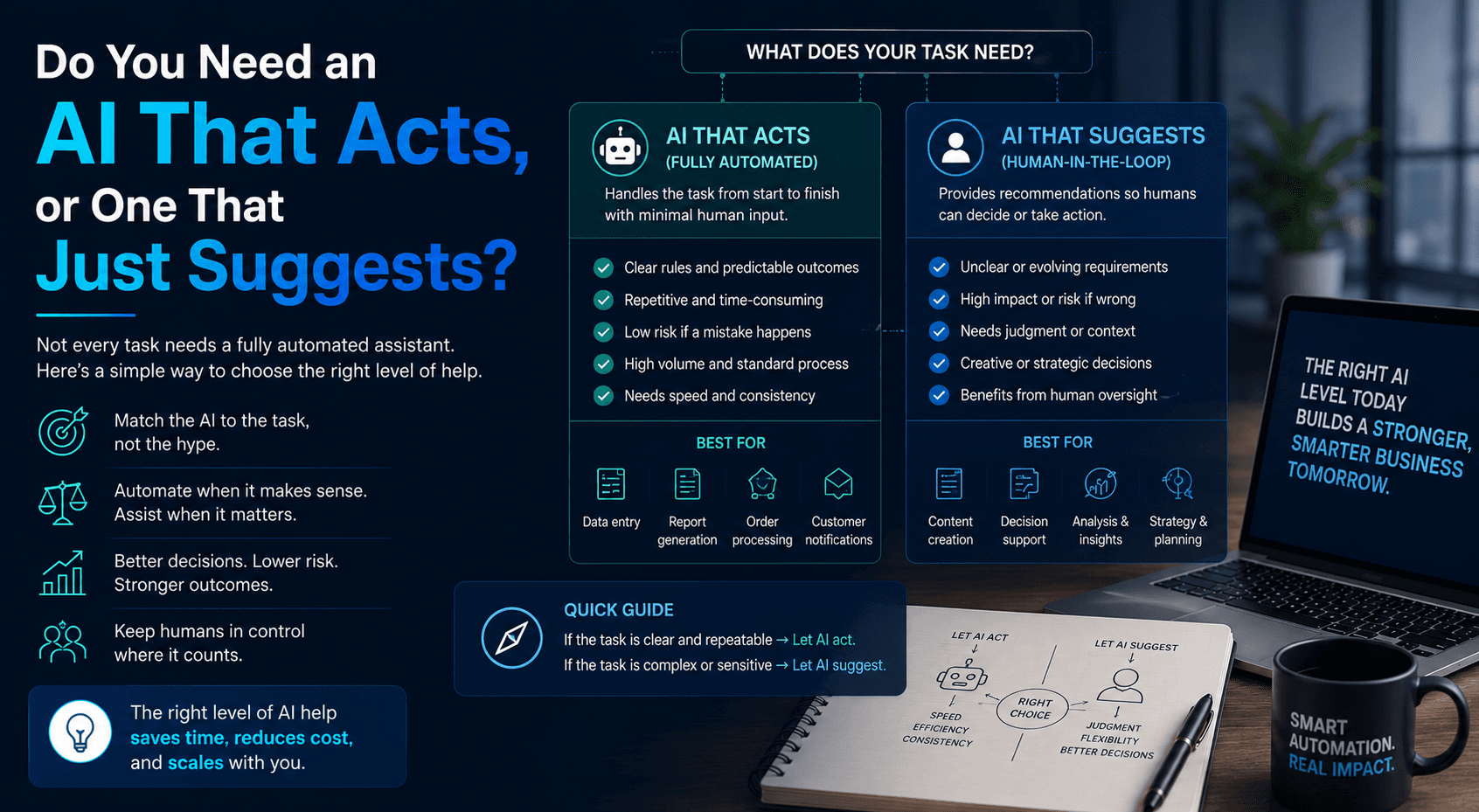
A copilot suggests. It drafts the email, summarizes the document, recommends the next step — and a human decides whether to use it. An agent acts. It takes a goal, makes its own decisions, and completes the task end to end: it doesn't just draft the reply, it sends it; it doesn't just flag the order, it processes the refund.
Both are useful. They're just suited to very different situations.
When a copilot is the right call
- The work needs judgment, taste, or context the AI can't fully see.
- Mistakes are expensive, public, or hard to undo.
- Your team is still building trust in the system.
- The task happens often enough to matter, but each instance is a little different.
A copilot keeps a human in control while removing the slow part — the blank page, the first draft, the research. For most knowledge work, this is where the biggest, safest wins are.
When an agent earns its keep
- The task is high-volume and repetitive — too much for a person to keep up with.
- The rules are clear enough that a wrong decision is rare and recoverable.
- Speed matters more than nuance — replies that must go out in seconds, around the clock.
- You can give the agent clear limits and a clean way to escalate what it can't handle.
Give an agent the work that's too repetitive for a human and too risky to leave undone. Give a copilot everything that needs a human's judgment.
The safe way to go from one to the other
You don't have to choose once and forever. The smart path is to start a task as a copilot and graduate it to an agent only after it earns trust. Let the system suggest for a few weeks while a human approves each action. Watch how often it's right. As confidence grows, hand it more autonomy on the easy cases and keep humans on the hard ones.
That's how you get the speed of automation without betting the business on it. The level of help isn't a fixed setting — it's a dial you turn up as the evidence comes in.
The question to actually ask
Don't ask "should we use an AI agent?" Ask, for each task: what does a mistake here cost, and how often will it happen? When the answer is "a lot" or "often," keep a human in the loop. When it's "little" and "rarely," let the machine run. Get that match right and the technology almost takes care of itself.
Written by StayClever Team