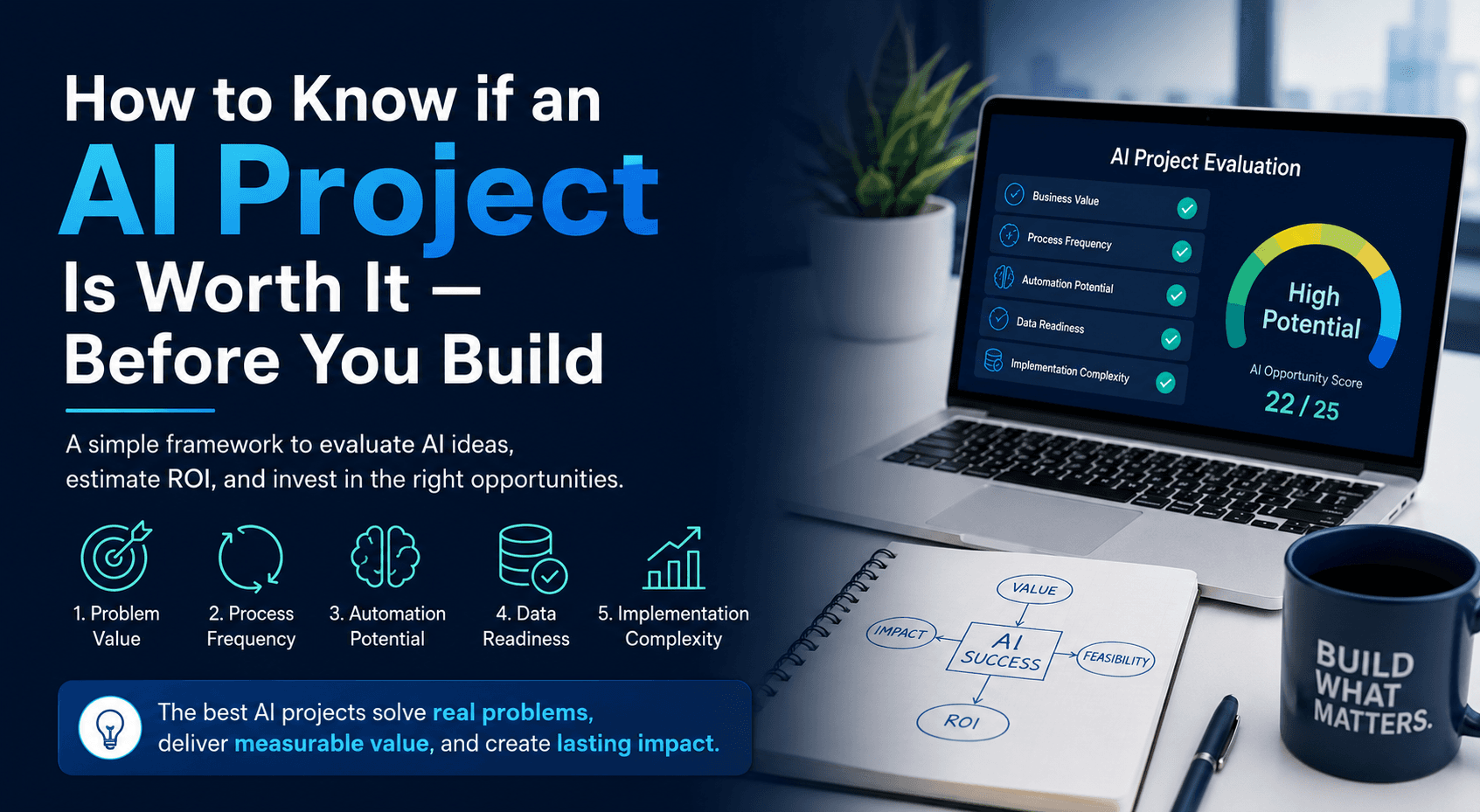
Most failed AI projects don't fail in the build. They fail in the decision to build at all. The idea sounded exciting, a vendor demo looked slick, and nobody stopped to ask the boring question: if this works perfectly, what does it actually save or earn us?
You can answer that question in an afternoon — long before you write a line of code or sign a contract. Here's the way we size up an AI idea with our clients, so the ones we back tend to pay for themselves.
Start with the work, not the technology
Forget the word "AI" for a moment. Find one specific, repetitive task that costs you real money today. Customer emails that take three hours a day to answer. Invoices someone keys in by hand. Orders flagged for fraud one by one. AI is only worth it when it removes a cost you can already point to.
If you can't name the task and roughly what it costs, that's your answer for now: it's too early to build.
Put a number on the prize
Estimate the annual value of solving it. You don't need a spreadsheet model — a back-of-the-envelope number is enough to make a decision. Multiply hours saved per week by a loaded hourly cost, or take the revenue you lose to the problem today.
- Time saved: hours per week × weeks per year × cost per hour.
- Money recovered: errors, fraud, churn, or missed sales the system would prevent.
- Speed gained: faster replies or decisions that win deals you currently lose.
Be honest and a little conservative. If the prize is small even when you're optimistic, stop here — you've just saved yourself months.
Estimate the real cost — including the boring parts
The build is rarely the expensive part. The cost that surprises people is everything around it: cleaning up data, connecting to the tools you already use, training the team, and keeping the thing running after launch. A useful rule of thumb is that ongoing care costs as much again over a year as the initial build.
If a project only makes sense when you ignore the cost of running it, it doesn't make sense.
Look for a payback inside a year
Divide the cost by the annual value. If the project pays for itself in under a year, it's usually worth a serious look. One to two years, only if it also unlocks something strategic. Longer than that, and you're betting on a future that may not arrive — drop it and find a better idea.
Then de-risk it with the smallest possible test
Even a great-looking idea can hide a fatal flaw — messy data, a workflow that won't budge, a team that won't adopt it. So before the full build, run the cheapest test that could prove the idea wrong. A few weeks, a narrow slice of the work, real data. If it survives that, you build with confidence. If it doesn't, you've lost weeks instead of quarters.
That's the whole discipline: name the task, price the prize, price the work honestly, demand a fast payback, and prove it small before you build big. Do that, and the projects you green-light will be the ones worth finishing.
Written by StayClever Team